Designing safe, private and care-focused mutual aid experiences in times of crisis
Project Overview: Just before the COVID-19 pandemic hit, a team of technologists explored and prototyped what a safe, secure, connected and crisis-relevant mutual aid technology network would need to look like.
Dispatcher was an incubation project at Ushahidi to build a product that helped build community resilience before, during and after a crisis. Ushahidi took on this project after receiving funding from Rockefeller to develop an MVP and test in a country that had experienced both large-scale crisis and smaller, everyday life crises.
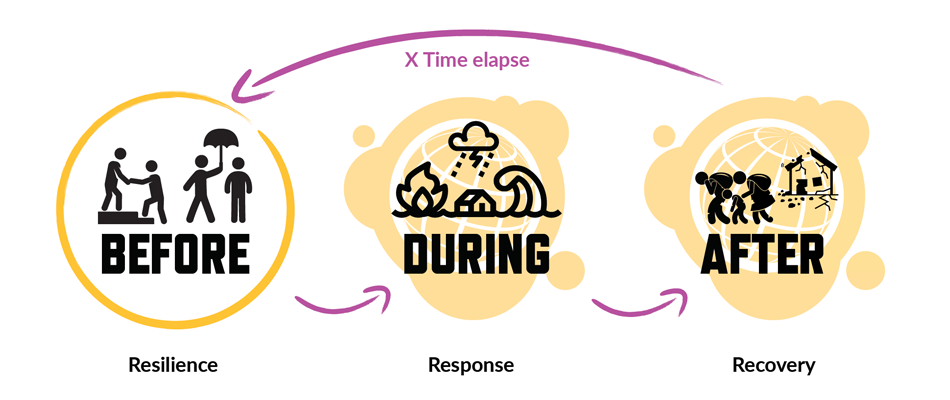
Above: Crisis lifecycle illustration
Over the course of 4 months a small team within Ushahidi designed, tested, developed and QA tested a minimum viable product. The design and community team then planned and carried out a rigorous in-country research trip where we tested the product in everyday and simulated crisis scenarios.

Above: Dispatcher MVP details

Above: Dispatcher MVP details
I shared the design role on Dispatcher with a colleague and I focused on the product design, management liaising with developers and testing the functions while my colleague focussed on the field research plan. We then collaborated to finish the research planning and shared the in-country field work which included:
- Usertesting sessions in the community
- In-depth unstructured interviews with users and stakeholders
- A stress-test for capabilities and user interactions
- User journey mapping and group test session
- Story building with the younger communities
- Promotional large scale events and ad-hoc testing at these events
- Reporting and synthesizing the findings with the core internal team

Above: User testers with dispatcher
 *Above: Interviewing community members for dispatcher
 *Above: Synthesis of dispatcher results
At the end of the project, we produced a report to our funders and devised several talks and workshops around the subject of designing for people in crisis.